
Down on the farm
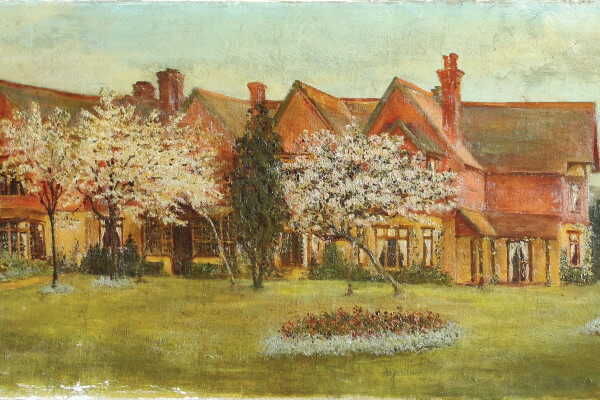
Local historian Tim Amsden tells the tale of Home Farm, the subject of a new display at Tring Local History Museum, and its former residents.
A newly-restored oil painting has gone on show at Tring Local History Museum, with a display telling the fascinating story of its subject, Home Farm, off Park Road.
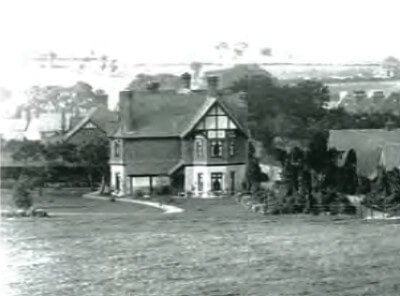
Home Farm is the name of a complex of buildings that can be glimpsed from Park Road. There are several collections of buildings, formerly used as a dairy farm but now converted into residential accommodation. To one side is the farmhouse, but that description hardly does justice to one of Tring’s most splendid houses, which has had some fascinating residents.
It was built in 1890 as part of Lord Rothschild’s wide-ranging modernisation of his estate. That was a severely difficult time for British agriculture, following years of bad weather and poor harvests, with cheap grain imports and refrigerated meat shipments adding to the problem. Rothschild decided to invest his way out of the crisis, spending considerable sums in the process.
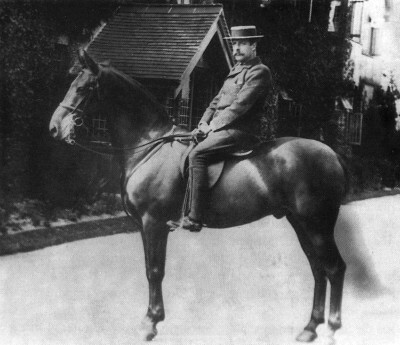
He appointed Richardson Carr, who had a track record of farming innovation, to run his estate. Home Farm was largely built to his specification, and soon held a pedigree herd of Jersey dairy cattle. The house was built to a high standard, taking into account Carr’s need to carry his invalid wife Mary upstairs at night.
Early in the farmhouse’s existence, Richardson Carr’s sister, Kate Gardiner Hastings, visited and made the painting of it in springtime. Kate was of the Pre-Raphaelite school, a friend of the painter Sir Edward Burne-Jones; she knew the actress Ellen Terry and had painted portraits of Ellen, her children Edith and Gordon, and the actor Sir Henry Irving. The Carr family was remarkably talented; one brother, Jonathan, developed the ‘artistic’ Bedford Park estate in West London, and another, Joseph, was joint director of the famous Grosvenor Gallery. Kate’s son Patrick became an MP.
Disaster struck twice within five years. First, Mary Carr died, and then on a bitterly cold night in February 1895, the house caught fire. Carr got his eight-year-old daughter Kitty, her governess Alice Fox and the household staff out safely, while fire engines from the mansion and the town battled to get the flames under control. The water pressure was inadequate and the firemen’s coats were frozen stiff – the house was completely destroyed. It was duly reconstructed, with two rooms added to the south-west corner.
Remarkably, at 58, Richardson Carr joined up in 1914 and did ambulance duty on the Western Front for a few months, until the death of Lord Rothschild necessitated his return. There followed a series of stock sales in which Carr’s achievement was systematically dismantled. In 1916, after a dramatic incident at a council meeting, he moved away, but continued his Tring duties until his death in 1928.
Home Farm was occupied briefly by Walter, the 2nd Lord Rothschild, until his death in 1937. It became a maternity hospital in 1940, and was later sold to a succession of private owners, including Mr and Mrs Moss and their children, Stirling and Pat, whose careers in the motor-racing world are legendary.
So what became of Kate’s painting? Carr perhaps gave it to Alice Fox as a keepsake; she remained in Tring, at Forge Cottage, until her death in 1940. Much later, possibly during the 1970s, it was passed to Brian Planton, the High Street jeweller, known for his interest in Tring’s history.
When the History Society began, Brian made a gift of it. It remained in Dacorum Heritage Trust’s store before we had our own museum, and being dirty, in poor condition and minus its frame, it needed a lot of TLC.
We obtained quotes from conservators and after several failed bids, secured a generous grant towards the cost from Hertfordshire Heritage Fund. Art restorer Therese Prunet-Brewer and her husband Al undertook to get the painting back to sound condition. Adrian at Tring’s Picture Box re-framed it and the painting is now proudly hanging in the museum in Brook Street, which is open free of charge on Fridays and Saturdays. Come and see!
Tring Local History Museum is open Fridays and Saturdays 10am-3.30pm. tringlocalhistorymuseum.org.uk
Pictures © Tring and District Local History Society / Tring Local History Museum