
Building on our history
We take a look at some of Tring’s most interesting buildings, with this extract from the book Tring in 50 Buildings, by Paul Rabbitts.
1. Old Grove Farm
One of the oldest buildings in Tring is the original Tring Grove farmhouse on the corner of Marshcroft Lane, now named Old Grove Farm, which is one of the best examples in north-west Hertfordshire of a crown-post house used as a domestic dwelling. It is reputed to have been built between 1380 and 1480 with a late 17th-century rear wing.
This building served as the farmhouse for Tring Grove Farm up to about the end of the 19th century, when a new and larger farmhouse was erected on the north side of Marshcroft Lane. In the 1920s it was occupied by the Halstead family until they emigrated to Canada in 1931.
2. Parish Church of St Peter and St Paul
The church of St Peter and St Paul in the heart of Tring is over 700 years old, with its register dating from 1566. The church contains many interesting monuments, including that of Sir William and Lady Gore of Tring Park. Sir William is shown wearing the robes of the Lord Mayor of London. Less obvious is one to Mary Anderson of Pendley Manor, with the coffin lid on the floor of the north aisle, which dates from 1200.
Many of the stained-glass windows in the church are by the Victorian firm C. E. Kempe. Charles Eamer Kempe (1837–1907) was a British Victorian-era designer and manufacturer of stained glass. His studios produced more than 4,000 windows and also designs for altars and altar frontals, furniture and furnishings, lychgates and memorials that helped to define a later nineteenth-century Anglican style. The list of English cathedrals containing examples of his work includes Chester, Gloucester, Hereford, Lichfield, Wells, Winchester and York.
3. The Bell Public House, High Street
Probably the oldest public house in Tring is The Bell, which remains on the High Street. It was certainly in existence in the early part of the 17th century as it was reported in 1611 that ‘Henry Geary was before the Justices for keeping The Bell without a licence and a few years later for drunkenness’. By 1841 there were six members of the rather unusually named Christmas family living here, with the young Thomas being the ‘victualler’.
In April 1937 it was decided to convert a number of old buildings at the rear of The Bell into garages. The works revealed some fine old beams which experts thought may date back to the 13th century. This building was formerly a coach house for the mail coaches and there were still hayracks and troughs for horses. While the garages are no longer used, the wonderful old beams are still in existence, holding up the roof as they have done for centuries.
4. Tring Park and Mansion
Tring Park was built in approximately 1682-83 by none other than the architect of St Paul’s Cathedral, Sir Christopher Wren, for Henry Guy, who was Secretary of the Treasury to Charles II as well as Groom of the Bedchamber. A later owner was Sir William Gore, who was Lord Mayor of London in 1645 and a founder member of the Bank of England. It was eventually purchased in 1872 by Baron Lionel de Rothschild, as a wedding present for his son Sir Nathaniel (later Lord) de Rothschild. It was partly rebuilt by the Rothschild family, but retaining Wren’s plan and conception, with the interior extensively refitted in Wren’s style.
By 1888 Nathaniel Rothschild had encased the Wren house with the house you see today. He doubled the house in size and added another floor. The family had moved out by the start of the Second World War but used the mansion for back office functions of the Rothschild Bank and as a place of safety for expectant mothers from the East End of London, helped by their Jewish charities. The school arrived in 1945 and has been present ever since.
5. The Robin Hood, Brook Street
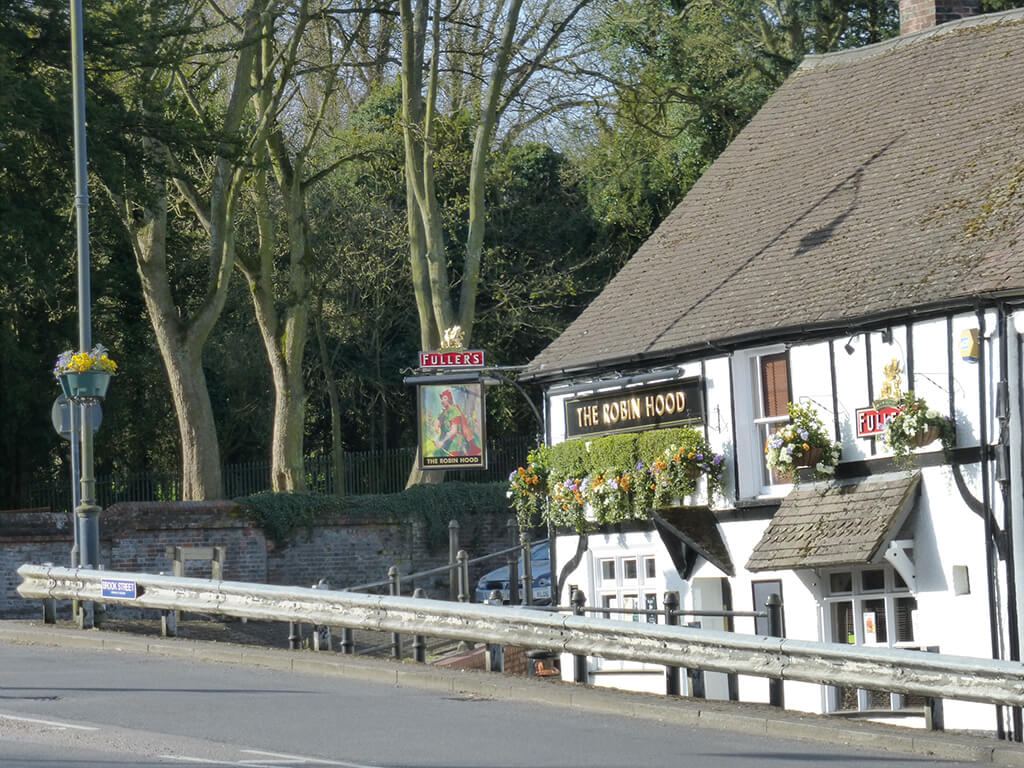
The Robin Hood, on the corner of Brook Street, is one of the oldest buildings in Tring, and dates back to the 17th century. Local press coverage reports of a number of unsavoury incidents in The Robin Hood. The Bucks Herald of 26 October 1872 reported ‘Elizabeth Lovett, of Tring, was charged by Sergeant Aldridge, with using oaths and profane language at the Robin Hood public house, Tring. She was very abusive, and was brawling about from ten o’clock to one in the morning. She would not be quiet and go home, as he requested her. She said she never saw Sergt. Aldridge at all. She was ordered to pay 14s.6d. fine and costs.’
The pub hit the headlines in 2023 when Hollywood star Keanu Reeves visited it while in the area, opting for a local lager and a shepherd’s pie!
6. The Former Plough Inn, No. 50 High Street
This is one of the oldest buildings in Tring and has changed very little over many decades. The Friendly Society held meetings here in 1794 when it was already called The Plough Inn. In 1905, The Plough was transferred to the Herts Public House Trust Co. Ltd, which had the Rose and Crown, and The Plough was used as a booking office for the hotel. It was eventually purchased by Mr John Bly, Snr, for his antique business. When he died in 1937 it was carried on by his son, Frank, and then Frank’s son, John [of Antiques Roadshow fame]. He eventually transferred his business to London and the property became New England House Antiques, followed by a vegetarian restaurant and coffee shop, and it has remained a restaurant since then. Next door premises at Nos 51-52 were commandeered by the Royal Navy in 1940 as HMS Aeolus, making kites and balloons for the war effort.
7. Grace’s Maltings, Akeman Street
One could almost miss Grace’s Maltings, almost hidden and out of the way off Akeman Street. Today, what remains has been converted into residential properties. The former entrance to the maltings was off Akeman Street to what was a malting and mill, which dated from medieval times right up until the First World War. After the war, it was run as a corn mill for another 50 years and took its name from Frank Grace and his sons Thomas and Robert, who ran it later. By the 1980s, the mill had ceased operation and had been bought by property developers, who converted many of the buildings and surrounding area into private dwellings.
The former Grace’s Maltings is much altered, but does include the remnants of the early 16th-century hall house of cruck construction, floored in the 17th century. It also has a north cross-wing with kiln, maltings, and grain store.
8. The Former George Public House, Frogmore Street
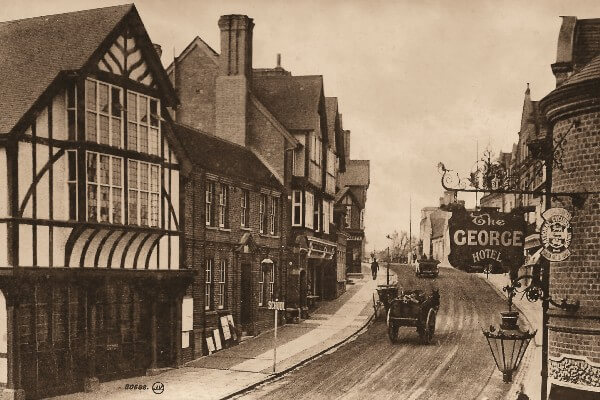
The original George public house was not on the corner of the High Street but in Frogmore Street, beyond a shop that stood on the corner. In 1806, it was described as ‘a small hostelry and corn chandler’ held by Mr Joseph Tompkins.
A new building of the George Hotel was planned on the corner of the High Street as reported in the Bucks Herald on 13 February 1897. It said: ‘The Aylesbury Brewery Company will move the new George Building 7ft 6in higher up from Frogmore Street and fill in the cellar at a cost of £150.’ By late summer, the building was under construction. It was not the only time that the George was to feature in the local newspapers. In 1900, the new licensee that had taken over from Mr John Saunders, who had died suddenly of an apoplectic fit, had an issue with one of his customers. On 17 March, the paper reported: ‘An elderly man received serious injuries while being forcibly removed from the George Hotel. He cut his head and face severely. Several versions of the affair are in circulation.’ The headline the following week read, ‘Pushing an old man down the George steps.’ The licensee Alfred Horwood was charged with assaulting and beating the old man at Berkhamsted Petty Sessions, but the magistrates dismissed the case, clearly of the view the ‘assault’ was justified.
The building is now home to Costa.
9. New Mill Baptist Church
The Baptist Church at New Mill is one of the oldest in Hertfordshire, established in the period of religious liberty that prevailed between the Civil War and the restoration of the monarchy. The present church and Sunday school buildings were built in 1818 and 1897, respectively, but the history of Baptists at New Mill goes back to the time of Oliver Cromwell. In, or about, the year 1655, six persons formed themselves into a Baptist Church. Their first place of worship was a mud walled cottage which stood close to the site of the present building.
In 1666 the Five-Mile Act came into force, forbidding any Nonconformist minister from being within 5 miles of any place where they had been ministers. Records state that ‘the little church at New Mill had to leave their retired meeting house, and go into the woods to worship God, for fear of their persecutors.’ Their night-time meeting place was discovered and the pastor Richard Sutton was arrested and sent to prison, where he remained until the death of Charles II. Richard Sutton was then freed and New Mill chapel was reopened; around this time John Bunyan is reputed to have visited and preached on several occasions.
Tring in 50 Buildings, by Paul Rabbitts, is published by Amberley Publishing & Quiller Publishing, www.amberley-books.com.
Copyright, Amberley Publishing – All Rights Reserved