
Nature and wildlife

In the first of a series of columns, Berkhamsted wildlife expert Ian Gamble looks at the reasons for the decline of British wildlife, and highlights the nature we can find on our doorstep.
I was introduced to the natural world by my father. He was a good all-round naturalist, and during my childhood he taught me about animals, birds, butterflies, moths and plants.
When I reached the age of 18, I became a licensed bird ringer under the auspices of the British Trust for Ornithology. I have now been a ringer for 52 years and have processed nearly 24,000 birds.
I started to get interested in moths when in September 1963 an adult death’s-head hawkmoth was brought to our house.
This wonderful creature ended up, for a short while, in an old biscuit tin on the windowsill in our front room, and for a young seven-year-old boy this was insect heaven! This moth actually squeaked at me as I gingerly lifted the lid and looked in. Over the years, I have also maintained my interest in moths and so far have caught 815 species in my Berkhamsted garden. Butterflies are another passion of mine and I have been fortunate enough to see and photograph all of Britain’s 59 resident and common migrant species.
Over the years my enthusiasm for studying the natural world has never diminished and it still continues to fill me with awe and wonder.
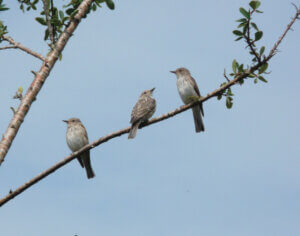
It is hard for me to comprehend what we have lost during my lifetime. In the small garden in Leicestershire where I spent my childhood, spotted flycatcher and tree sparrow nested in the nestboxes on the house.
Marsh tit and willow tit constantly fed at the birdfeeders during the winter months, and family parties of bullfinch came in during late summer to feed on the seeds of herb robert and honeysuckle berries.
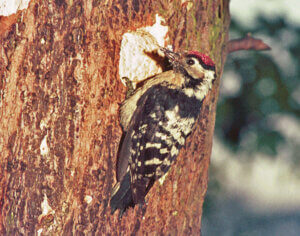
As children we played along the local stream and in the adjacent meadowland. Water voles were numerous and easily seen, and the call of the lesser spotted woodpecker was frequently heard in the streamside alders.
Since the 60s and early 70s all these species have declined: Spotted flycatcher -92%, tree sparrow -93%, marsh tit -83%, willow tit -97%, bullfinch -55%, water vole -90% and lesser spotted woodpecker -91%.


Biodiversity is the scientific measure of the variety of species on Earth. A diverse biodiversity is an intricate web of life that has inbuilt checks and balances stopping individual species becoming dominant and destroying other species. How species interact together within their environment is called ecology.
Each animal or plant has an important role to play within its habitat, and many have complex relationships one with another, many of which we are only now just starting to understand. Pristine habitats work in equilibrium, but if we lose species or introduce alien species then intricate relationships are broken and the checks and balances destroyed.
The World Wide Fund for Nature’s Living Planet Report 2024 states that there has been a 73% average loss of global wildlife populations since 1970. When the State of Nature 2023 report was published it showed that the UK has one of the lowest biodiversities in the world, with only 50.3% remaining. This put the UK in the bottom 10% of 240 nations and territories.
The global average for all nations is 79%, which is considerably lower than the 90% average considered to be a safe limit for guaranteeing the planet does not fall into an ecological collapse that could result in widespread starvation. These figures aren’t arbitrary but have been attained by years of recording and research.
The five main reasons for biodiversity decline are:
- Changes in land and sea use caused by deforestation, intensive monoculture and urbanisation.
- The effects on the natural world caused by climate change.
- Land, water and air pollution all have a significant effect.
- Direct exploitation of nature which includes hunting and over-fishing.
- The introduction of alien species.
Autumn Focus on Ivy
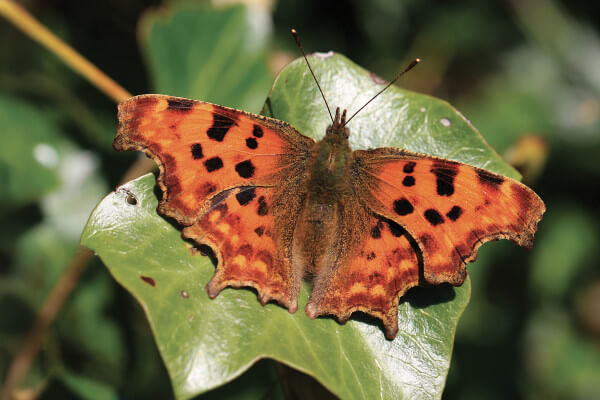
This autumn I am asking you to go out on a sunny day and watch the abundant life that ivy flowers support. From a biodiversity point of view the ivy is one of Britain’s most important shrubs, flowering from September to November.
It’s one of the last native plants to flower during the year, and it provides a rich source of nectar for bees, social wasps, hoverflies, butterflies and moths. It’s very important for pollinators, for species such as the buff-tailed bumblebee, prior to them going into hibernation. Over 85% of pollen brought into honeybee hives during the peak Ivy flowering period, comes from ivy. It’s an incredibly rich food source for both pollen and nectar, the latter containing about 49% sugar. It helps the honeybees replenish their stores, enabling them to survive the cold winter months.
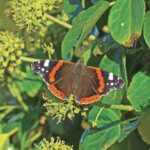
Some moths emerge just to take advantage of ivy’s nectar. Three interesting species that feed on ivy flowers are the green brindled crescent and merveille du jour – the latter translates from the French meaning wonder of the day – and the herald, an unusually shaped moth that hibernates. Butterflies also take advantage of the nectar, including the comma and peacock, which feed up before going into hibernation, whereas the red admiral feeds up before migrating back towards the Mediterranean. However, in recent years, because of global warming some now hibernate here.
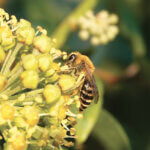


The ivy mining bee became naturally established in Britain probably due to global warming in 2001. It feeds on the ivy’s nectar between September and October.
Ivy leaves are the larval foodplant of the holly blue butterfly, the swallow-tailed moth and the angle shades moth. Its thick evergreen foliage provides roosting sites for birds and hibernation shelter for butterflies and moths such as the brimstone and comma butterflies and the herald moth.
Its berries ripen during the winter from late January through to early April. The berries are highly toxic to humans and pets but are very nutritious and high in fat content for birds. Wintering blackcaps, blackbirds and redwings, along with woodpigeons take full advantage of this early food bonanza. For many years ivy has been a much-maligned plant and it has long been considered something to be destroyed. In fact we should all have a mature ivy in our gardens to help our diminishing insect population.
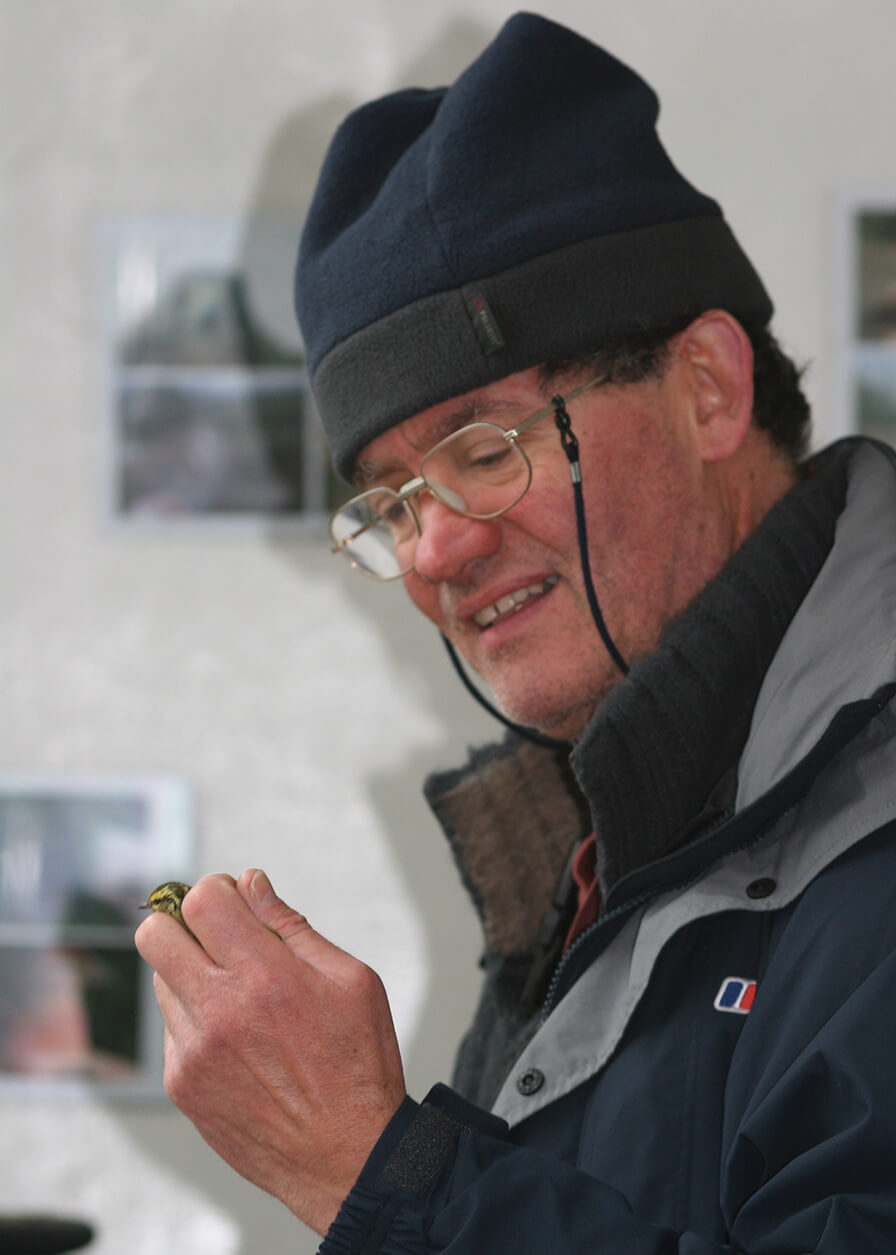 About Ian: Ian grew up in Leicestershire and from an early age was interested in the natural world. In the 1960s he became a junior member of the Loughborough Naturalists Club (LNC) and later served on its committee, becoming chairman in 1983. He has written two books that were published with the help of the LNC; The Birds of Swithland Reservoir in 2001 and The Birds of Ratcliffe-on-the-Wreake Gravel Pits in 2002. Between 1987 and 1990 he served on the Leicestershire and Rutland Rarities Committee, a body that evaluated all rare birds seen in the two counties. In 1991 he moved to Berkhamsted, where he has continued with bird ringing and moth recording. Throughout most of his adult life Ian has led guided walks and given illustrated lectures on wildlife.