A History of Lime Walk
Berkhamsted resident Jenny Thorburn, who is researching the history and geography of Berkhamsted Common, uncovers the 500-year-old history behind a part of Berkhamsted that will be familiar to many local walkers.
One of the most direct routes to the beautiful countryside north of Berkhamsted is to go uphill from the castle side of the station, over Bridgewater Road, and follow Castle Hill Avenue until it bends left.
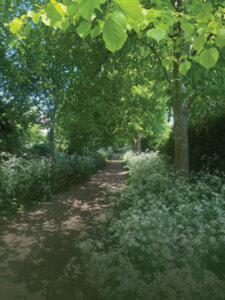
Next you cross a small green space with a little Christmas tree, and then head up an earthen path under trees to emerge at the top of Castle Hill, where the track to the fields and beyond starts. As you walk, you might notice a line of lime trees on the verge of Castle Hill Avenue, and two lines of the same trees up the green path.
This green route from the town to the country is a remnant of the landscape that was here before the housing was built in the 20th century. It’s a way that is at least 500 years old. The earliest evidence for this path is on a map made in 1612, which shows a track running from near the castle to a mansion on top of the hill. This mansion was built by one of Queen Elizabeth’s courtiers, using stone extracted from the castle, and presumably brought up this way.
Lime tree avenues
By the next century, an additional route had been made to the mansion, along the line of the present Castle Hill. In the early 18th century these two ways were planted with avenues of lime trees. At that time, the Rooper family owned Berkhamsted Place, and it is likely that they were responsible for the landscaping. Then it was the fashion, influenced by French and Dutch trends, for landowners to plant long avenues from their mansions across their estates. Cassiobury, near Watford, was one of the trendsetters. Some of those avenues are still there, and also at Tring.
Lesser landowners followed the fashion for avenues, such as here in Berkhamsted. The hybrid common lime tree (Tilia x europaea) was imported from Holland as it has characteristics that made it particularly suitable for avenues, and it has been widely used for formal plantings and as a street tree ever since.
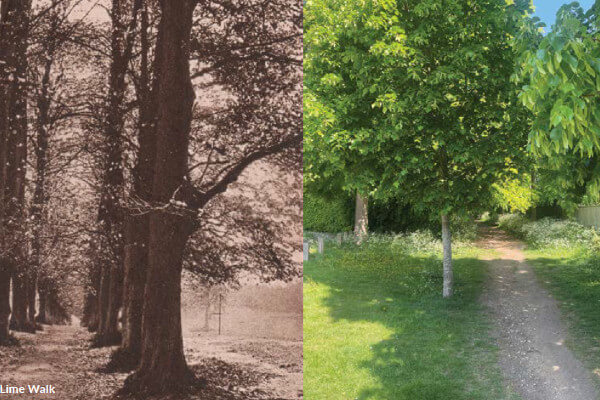
From maps, it appears that the avenues along the way to Berkhamsted Place remained throughout the 18th century. At the start of the 19th century, Lord Bridgewater let Berkhamsted Place to a succession of tenants. Colonel Finch lived there from 1847 to 1872, and it seems most likely the old avenue was replanted during the early part of his tenancy, again with lime trees. They were set closer together, leaving only room for a footpath between them. This was a landmark in the town and was called the Lime Tree Avenue, although one map calls it Lover’s Walk.
Land sale
In the 20th century, Berkhamsted Place and the surrounding lands were sold off by the Brownlow estate trustees. In those sales they were careful to covenant that this footpath should remain open.
The lower part of Castle Hill Avenue was laid out by the Corolite Construction Co. in the late 1930s. The position of the eastern end of the road was determined by the edge of the avenue. The avenue was retained on a wide verge in front of the new houses.
Aerial photographs from 1948 show the avenue intact in the new development.
When the land on each side of the upper part of the avenue was developed after World War II, the avenue’s western trees were included within the plots. The path in the avenue was kept as a registered public footpath, called Lime Walk. You can see some of the old stumps, with regrowth, inside the garden fences.
Replacement trees
In 1984, the avenue trees were considered to be at the end of their lives and were felled by Dacorum Borough Council. One of the old trees was left; it’s the first one you come to near the bottom of Castle Hill Avenue.
For the avenue’s third planting, the council chose the same common lime trees, planting them in a single line up the verge, and in a staggered double line up Lime Walk.
In 2010, the Berkhamsted Citizens’ Association planted three more new trees, this time large-leafed limes (one of the parents of the common lime). In this way this historic feature of the Berkhamsted landscape was renewed for future generations.