
Coopers – From modest vet to global sheep‑dip empire
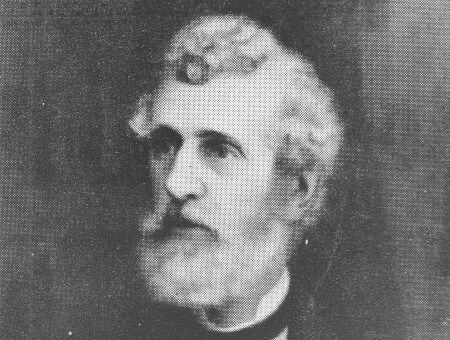
Berkhamsted once rang with the clang of steam engines and the drift of yellow arsenic dust. At its heart stood Coopers of Berkhamsted, a pioneering agricultural chemical firm that began as a one-man veterinary experiment and became a global brand.
The company’s founder, William Cooper, started life in modest circumstances, but his innovation reshaped farming practices worldwide.
In 1842, William Cooper, a trained veterinary surgeon from Shropshire, arrived in Berkhamsted with, it is said, little more than a black bag containing his belongings, and the tools of his trade.
By 1851 he lived in a small house on the High Street and later moved to a house called The Poplars (which was later the birthplace of Shakespearean actor Michael Hordern, perhaps best remembered for narrating the TV series The Adventures of Paddington Bear from 1975-1986).
It was in his Berkhamsted home that William Cooper carried out experiments on curing sheep scab – an incurable skin disease. At the time, farmers relied on crude ointments made from tar, goose fat, tobacco stalks and brimstone, with little success.
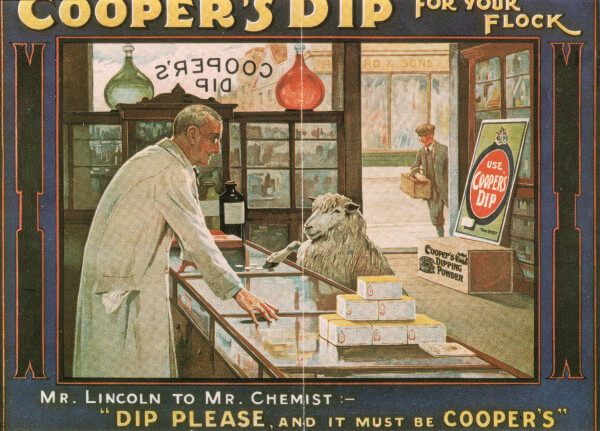
Between 1843 and 1852, Cooper conducted systematic experiments blending arsenic and sulphur. His breakthrough came in the early 1850s: a stable, powdered sheep dip that could be standardised, packaged, and easily transported. Cooper’s Dip launched in 1852.
To scale production, Cooper established a powdered-dip mill in Ravens Lane in 1852. Over the next decades, his factory was extended multiple times, around Manor Street and Ravens Lane, adding steam-powered mills, kilns, sulphur-dressing machines and even an in-house printing press to create distinctive lithographic labels that deterred counterfeiters.
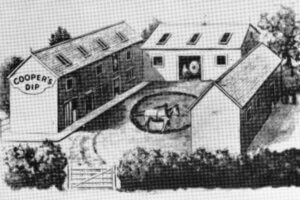
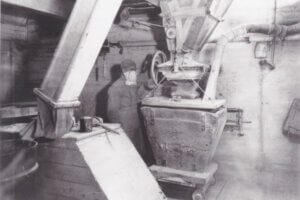
In 1868, a nephew – William Farmer Cooper – joined the operation, and initiated their overseas trade.
In 1880 two more nephews – Henry Herbert Cooper in 1880 (who died in 1891 aged 31) and Richard Powell Cooper – joined the firm, and William Cooper & Nephews was born.
William Farmer Cooper died aged 37 in 1882, while his uncle, William Cooper, died three years later in 1885. His employees were reportedly sad at the loss; though a stern and hot-tempered boss, William had also been fair, and many employees stayed with the company for the whole of their working lives.
The deaths left Richard at the helm and he led the company to expand its global footprint and diversify into livestock exports. In 1905, Richard was awarded a baronetcy for his contributions to agriculture and industry.
By the late 19th century, Coopers was exporting dip worldwide. In 1898, Richard Ashmole Cooper – Richard Powell Cooper’s son – became partner. He introduced a revolutionary machine to weigh and wrap dip packets, and founded the Cooper Research Laboratory on Ravens Lane. When his father died in 1913, Richard Ashmole took over leadership, serving simultaneously as Member of Parliament for Walthamstow West.
In 1925, Richard Ashmole Cooper led a merger with McDougall & Robertson Ltd to form Cooper, McDougall & Robertson Ltd (CMR). He served as chairman until the company’s broader expansion – including research and printing divisions – solidified its corporate footprint in Berkhamsted.
During World War II, CMR leveraged its expertise to produce Anti‑Louse Powder (AL63), a dustable mix designed to kill the lice that caused trench fever and typhus. After testing more than 100 formulations, the chosen version – AL63 – contained the insecticide DDT, marking a critical public health innovation. Many local residents later used AL63 as a garden pesticide.
As synthetic insecticides emerged in the 1950s, traditional powdered dips went into decline. Production in Berkhamsted ceased in the early 1950s, marking the end of over a century of local manufacturing. But Coopers had already reinvented itself through new ventures.
With the closure of the dip lines, Coopers pivoted into aerosols – installing Britain’s first large-scale aerosol filling plant at Berkhamsted. Early products included Cooper’s Fly Killer, later Freshaire, Woodworm Killer, and Crawling Insect Killer.
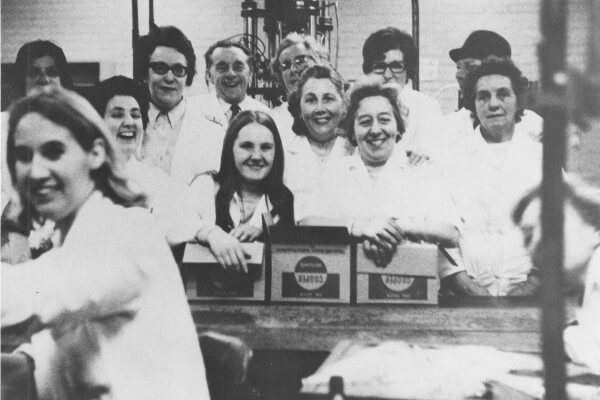
The new subsidiary, PAFCO (Pressure Aerosols Filling Company), filled packets for clients such as Palmolive Rapid Shave, and by 1965, the 100‑millionth aerosol had been produced locally.
Richard Ashmole Cooper died in 1946, and the company was acquired by the Wellcome Foundation in 1959. The Berkhamsted plant gradually wound down – by the early 1970s only a single aerosol line remained – and the printing press closed in 1979. The final site – including veterinary research facilities – was transferred through a series of pharmaceutical mergers and ultimately closed in July 1997.
Boasting over a century in operation, Coopers was once the largest industrial employer in Berkhamsted, with its own canal wharf shipping arsenic, sulphur, and coal via the Grand Junction Canal. At its peak, the company’s influence extended beyond industry to local housing, research, and philanthropy – workers’ houses such as Sibdon Place survive as reminders of its presence.
Today, the chemical works have long gone. Sites once occupied by labs, presses and offices have been redeveloped into housing and community spaces – yet the imprint of Coopers lives on digitally, in archives and in the memories of local people.
A stained‑glass window in St Peter’s Church, depicting Christ enthroned surrounded by saints and martyrs, including Edward the Confessor and Hugh of Lincoln, accompanied by his pet swan, memorialises William Cooper, and the Cooper Vault is the largest memorial in Rectory Lane Cemetery.
What began as a vet’s experiment to ease the agony of sheep scab grew into an internationally recognised chemical business. William Cooper’s legacy lies in innovation, scientific rigour and adaptability – from powdered dip to aerosol household products.
Coopers is still acknowledged around the town – Cooper House on Ravens Lane is now an apartment block, but was originally the Coopers’ admin building. Across the road, Clunbury Court remembers the accounts department with the inscription ‘Site of former counting house’. And of course there are street names such as Cooper Way, Robertson Road and McDougall Road.
Coopers transformed agriculture, supported wartime health, and touched the lives – directly or indirectly – of countless farmers, consumers, and workers over more than a century.