
‘I like to be involved in projects’

As a trustee of Berkhamsted Castle Trust, Berkhamsted Local History and Museum Society and the Friends of St Peter’s, Dr James Moir is recognised as a driver of projects that boost and enhance community living. Berkhamsted Living finds out more…
As testament to his dedication to community projects, James Moir spent five years delivering the restoration of Rectory Lane Cemetery, which has now become a highly valued public space in the town; he is rigorously dedicated to protecting the Castle Fields heritage, and he is writing a book about the Rews, Berkhamsted’s celebrated late Victorian/Edwardian architects.
‘I like to be involved in projects’, is his modest response.
Three key factors shaped James’s passion for the historic environment.
First James grew up in the Old Rectory, affectionately known as ‘Nightmare Abbey’, in Aston Clinton.
‘My Dad bought it as a decrepit wreck just after he had returned from the war, where he had been a Japanese prisoner of war, and I lived there throughout my childhood,’ James recalls. ‘ It was called Nightmare Abbey locally, as a joke reference to the Thomas Love Peacock novel.
‘There was reputedly a headless female ghost, but there were also glis-glis, edible dormice, released by Walter de Rothschild from his ‘zoo’ at Tring Park, who scrabbled around in the attic and terrified me as a child as they sounded as if they were rattling door knobs.’
The rectory was designed by Edward Buckton Lamb, who also created Berkhamsted Town Hall. Lamb’s reputation as a ‘rogue Victorian revivalist’ – famed for his unconventional approach – instilled in James an appreciation for quirky, well-designed architecture.
‘Second, my Dad was head of education programmes at Thames Television, and produced several series on historic properties. Always scouting for new venues, he would take us unashamedly on unannounced ‘swishers’ up the drives of country piles.’
The third factor involved one of the teachers at James’s school, who based a whole term’s course on the Observer Book of Architecture. ‘I know five people who benefited from that inspired deviation from the standard history syllabus and who ended up in architecture-related professions,’ James recollects.
Born in Aylesbury, he commuted daily to school in Berkhamsted from the age of seven to 17, travelling by bus, motorbike, and occasionally hitch-hiking.
He considers his most challenging role was his first full-time job as a fieldworker for the Historic Buildings Resurvey of England and Wales, in 1984. Assigned to North Devon, he encountered medieval buildings daily but had no legal right of entry. Instead, he had to persuade wary farmers and homeowners to let him explore attics and roof spaces, often facing suspicion and reluctance.
As project director of Chiltern Open Air Museum for 14 years, he describes the museum when he joined in 1986 as five completed buildings, including a granary from Rossway Park Estate and a reconstructed Iron Age House. By the end of his tenure, the collection had grown to more than 26 buildings, with the 1946 prefab as his favourite addition.
After working as a full-time historic buildings consultant, James sought professional qualifications to conduct full property surveys. While training at Dacorum Borough Council, he joined the team assessing the explosion at the Buncefield oil depot on 11 December 2005.
The fire burned for five days, with the official investigation attributing the disaster to an overfilled fuel tank and failed safety systems, resulting in a vapour cloud ignited with the force of up to 30 tonnes of TNT.
James has written many publications – ranging from research on 173 High Street, Berkhamsted, regarded as the oldest extant jettied timber-framed building in Great Britain – to technologies for relocating buildings. In 2004, he helped restore this building, establishing its origins as part of a larger timber-framed structure dating from 1277-1297, rather than the small shop he had thought it to be.
His interest in the practicalities of relocating historic buildings led to a Churchill Fellowship in 2006, studying methods in the US, China and Norway.
‘I visited lots of house movers in the US, travelling on one occasion in one of their adapted monster trucks on a highway at 60mph with a house in tow,’ he says.
‘China was eye-opening; construction on the Three Gorges Dam involved re-locating an entire medieval town to a new higher spot five kilometres away, and this included the city walls, which incorporated a 20-ton tree growing out of the masonry.’
Now he is working on a slightly less monumental project – a book about the Rews, the Victorian/Edwardian architects responsible for many of Berkhamsted’s buildings.
What I love about…
What I love about the area
‘I grew up in the Chilterns and have been living in Berkhamsted for the past 26 years. I’ve written technical notes for the Chilterns National Landscape on brick, roofing and flint – so it’s particularly rewarding to see some great projects where this guidance has been followed. The flint note was inspired by visits to the Getty’s Wormsley estate, where the huge library there promoted a new generation of flint workers.’
What are your favourite places?
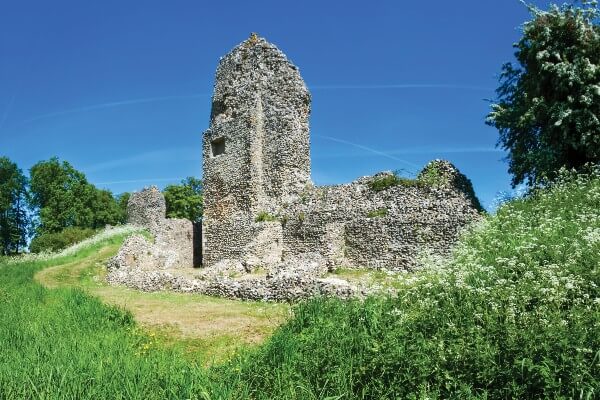
‘I’d have to say Castle Fields, wouldn’t I – for its breathtaking views over what used to be the Castle’s unique and enormous Royal Deer Park. Ashridge House is undoubtedly the most precious and massively impressive historic building locally, very much linked of course to the Castle in the past.
‘In Berkhamsted, the Dower House is my favourite coffee shop for morning meet-ups, Hill Farm Barn is a great place for tea, the Riser for evening company, and probably Tabure for a meal, but we’re so spoilt.
‘For a place of tranquillity, you can’t beat Rectory Lane Cemetery, but I’d have to say that too! It’s where my grandparents are buried, and they’re the only reason I’m here now in Berkhamsted – my grandfather moved down here in 1903 from Scotland to become a teacher at the Boys School.’
Photo © 2021 David Levenson