
‘It’s all thanks to Mary and her influence’
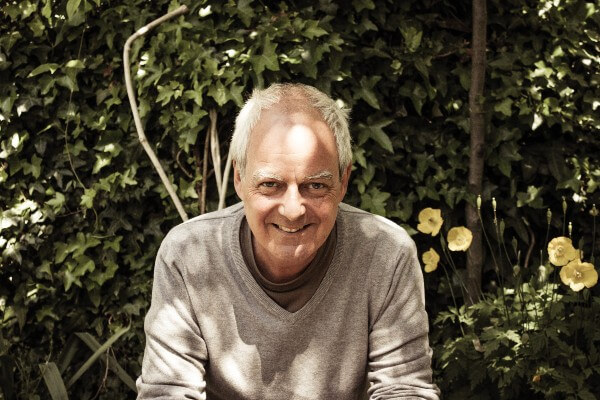
Following our story about pioneering journalist Mary Grieve in the spring issue of Tring Living, Dominic Cole OBE, distinguished British landscape architect and lead designer of the Eden Project, got in touch to share his story about the positive effect that Mary had had on his life and career.
Dominic Cole’s path into landscape architecture was led by his godmother Mary Grieve, whose presence in his life proved both nurturing and quietly transformative. ‘I have enjoyed over 40 years in the profession and have spent a lot of time working with historic landscapes – all thanks to Mary and her influence,’ he says.
Mary was friends with Dominic’s parents – his father, Dr Christopher Cole had a surgery on Tring High Street. Mary was, as he recalls, ‘a very conscientious godparent’, someone who remembered birthdays and Christmases and took an active interest in his life. She would sometimes collect him from boarding school and take him and his brother on outings – ‘my first time at the theatre and a memorable meal at L’Escargot among them’.
A particularly formative influence came through Mary’s friendship with the furniture designer Gordon Russell – Mary also sat on the Design Council. Visits to Russell’s home in Chipping Campden left a deep impression on Dominic, between the ages of eight and 13. ‘I was captivated by Gordon and his amazing garden,’ he recalls. Russell would take Dominic around the garden, explaining its design, including the carved stone seating he had made. It was Russell who first planted the seed of a future career, suggesting to Mary that the boy might be suited to landscape architecture.
This idea was taken seriously. Dominic’s father contacted The Landscape Institute to arrange a meeting with a local practitioner. ‘I have no recollection of the visit,’ Cole admits, ‘but must have gone along with the idea.’ It was enough, at least, to guide his academic choices: Geography, Biology, and Art at A-level. Years later, in a striking coincidence, he would be awarded the Peter Youngman Medal for Excellence in Landscape Architecture – named after the very man he had met as a teenager.
Dominic’s schooling began at St George’s in Windsor before he moved on to Stowe in Bucks at 13. Thanks to strong preparation, he was placed in an advanced class, skipping the usual introductory year. As a result, he missed the standard lessons on the history of Stowe and its gardens – ‘but knew I was somewhere special,’ he reflects. Academically, he describes himself as unexceptional, achieving ‘average grades at A level,’ but other aspects of school life proved more influential.
‘I hated games,’ he says plainly, and his stubborn refusal to participate led to an unusual arrangement. A sympathetic teacher allowed him to spend sports afternoons in the school’s kitchen garden instead. There, apprenticed to the gardener, he found genuine enjoyment: ‘happily pricking out seedlings… much more fun than running around a muddy pitch kicking balls’. The work, which included planting schemes for pensioners’ gardens as part of community service, reinforced his affinity for horticulture and landscape.
Despite this growing interest, landscape architecture remained obscure. When he mentioned it to his careers master, the response was bafflement: ‘He looked perplexed and said he had never heard of it’ – an irony, Dominic notes, given that the school sat within one of the most celebrated designed landscapes in the world.
After leaving school, it took Dominic several attempts to find a place studying landscape architecture, until Leeds Polytechnic offered him a last-minute vacancy. Missing the induction week meant he never received a formal introduction to the discipline: ‘I am still finding out,’ he adds wryly.
Dominic joined Land Use Consultants in Fulham intending to stay for a year; he remained for 30. Early projects were decisive. Work at Wrest Park near Luton, Beds, analysing the historical evolution of its gardens, sparked what he describes as a lifelong fascination: ‘I loved the detective work, the stories.’ At Audley End in Essex, he contributed to the recreation of a formal flower garden, part of a major archaeological effort that opened new approaches to understanding historic landscapes.
He also worked on the restoration of colliery spoil sites in the Midlands – ‘illegible moonscapes,’ as he calls them – learning how to establish vegetation without topsoil. This technical grounding would later prove invaluable in his work on Cornwall’s Eden Project.
In his thirties, Dominic returned to Stowe professionally, leading a major project for the National Trust. The process led to significant discoveries, including the long-overlooked base of a pyramid built by Lord Cobham. ‘As soon as I presented our plans,’ he recalls, ‘the archaeologist went there the next day and started digging.’
He has worked at many well-known historic sites across the country, including Dover Castle and Stonehenge. He also worked at Valence Park, a medieval manor in Dagenham, where two arms of its four-sided moat (dug in the 14th century) still remain.
Living in Tring
Dominic recalls: ‘We lived over the surgery in the High Street – I remember it well even though we left when I was 13, moving to Long Barn in Duckmore Lane. I shared a bedroom with my brother Jeremy.
‘I was sometimes allowed to help the staff mix medicines – probably not something that would be approved of today! – and prescriptions were put in an unlocked cupboard outside for patients to collect.
‘The main thing I loved was the huge garden. My Dad was a very good gardener and I trailed round after him learning plant names and how to garden.
‘The surgery was next to the butcher (Salarys), which used to have a slaughterhouse in the back. I can recall the thudding noise of what I now know were the bolts used to kill the animals. The fishmonger used to give my Dad the first-of-the-season cod roe, which we fried in bacon fat – another treat I still have every spring.
‘He was very popular with patients as he listened to them and was kind. He would take me on visits (aged about four or five) which the patients loved.
‘My Mum – Valerie – was a great cook, artist and mother, and I had an amazing upbringing.’