
Mary Grieve shaped a generation of women
Tucked within the village of Long Marston lies an extraordinary connection to one of the most influential voices in British women’s journalism.
Mary Grieve (1906-1998), was the long-time editor of Woman magazine and an advocate whose work shaped how millions understood family life, work and womanhood in the mid-20th century.
Although her career took her into London’s frenetic editorial offices, Mary’s periods of residence and association with Long Marston gave her a grounding in community, practicality, and the rhythms of rural life.
Born in 1906, Mary ‘Mollie’ Grieve grew up in an upper middle-class religious family in Glasgow. She moved to London to work as a journalist, after being advised by a leading Scottish publisher that journalism was not a career for women.
Her path into journalism was far from guaranteed. In the interwar years, opportunities for women in the press remained limited, but Mary possessed a keen instinct for understanding what readers wanted and needed.
She joined the staff of Woman magazine in the 1930s, as part of a team enlisted with the task of helping the struggling publication. In 1940 she replaced the male editor, who joined the RAF, and she remained in the role until the magazine was sold to the Mirror group in 1962. Then, aged 55, she retired.
During the Second World War, when uncertainty governed daily life, Mary’s editorial leadership became a stabilising force. Under her direction, Woman magazine offered not only morale-boosting stories but practical advice: stretching rations, repairing worn clothing, managing wartime budgets, coping with separation, and maintaining households under pressure. While official government messages tended toward the abstract, Mary’s guidance reflected lived experiences from villages much like Long Marston.
Over her 22 years in residence as editor of Woman she became a trailblazer for women in the publishing industry. At the height of its success, Woman had a circulation of over 4 million, and it was estimated that one in four members of the population (male and female) read it.
In Long Marston’s modest homes, women would have recognised in her editorials the tone of someone who understood the daily stoicism of rural life – someone who may once have stood in a queue at the grocer, walked a muddy lane in winter, or shared in the quiet rituals of village community.
After the war, Mary continued to shape Britain’s evolving ideas about womanhood. She oversaw Woman magazine at a time of sweeping social change: the rise of suburban housing, new household technologies, increasing female employment, and the cultural push-and-pull between traditional domestic roles and modern aspirations.
She treated these issues not as lofty trends but as practical questions affecting real families. How could a woman returning to work balance her ambitions with domestic expectations? What did new appliances mean for household budgets? Her solutions-oriented tone remained rooted in ordinary life.
Although she retired from Woman in 1962, Mary continued writing and advising on national committees. Her book Million Women: The Story of the Women’s Movement in Britain chronicled women’s wartime effort and helped cement her reputation not only as an editor but as a historian of women’s lives.
For a village proud of its history, Mary Grieve remains one of its most remarkable threads: a woman who helped shape a nation’s understanding of itself, one thoughtful story at a time.
Mary in Long Marston
James Kempton, chair of Tring Rural History Group, writing in Long Marston Village News, describes Mary’s life in Long Marston.
Mary Grieve and Dee Powell lived in Old Church Cottage, the thatched house at the bottom of Chapel Lane, from soon after the start of World War II to the 1970s. It was sitting in that cottage that Mary wrote her autobiography [Millions Made My Story (Victor Gollancz Ltd,1964)]. Dee is a constant presence in Mary’s autobiography, without her ever describing the nature of their relationship, as was common in those times. It seems the village was very accepting of the two women living as a couple: no one sought to label their relationship either.
It was Dee who found the cottage as a refuge from London and the Blitz. It seems she had friends in the village and it was convenient for Woman’s printers, Odhams in Watford. First they rented Old Church Cottage from the Gregory’s at 10 shillings (50p) a week, then as they gradually – and unexpectedly – fell in love with Long Marston and its residents, they bought it. Improvements were made and in echoes of the cottage’s later owners the Noakes, much effort went into the garden.
They played a very active part in local village life, especially Dee (or Miss Powell as she was known in the village), as Mary was often away in London for work. They loved giving parties for family, visiting friends and for local children. One of their major investments was putting in a swimming pool, which was very popular, especially Miss Powell’s swimming lessons for children in the village. Young people played an important role in their lives. Mary Grieve had four god-children in the village (including my husband Tim’s late aunt Gill Allen).
Mary sums up their life in the village beautifully: ‘In the summer, waves of young people come down to our pool and as evening falls, we sit under the Clematis montana and fry sausages and brew coffee and look out along the old moat past the Norman tower to the sunset and continue our conversation till the western sky is dark and the stars are up.’
Read more at www.tringruralhistory.co.uk
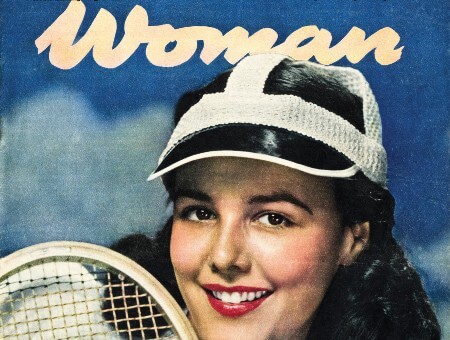
Image from a 1946 cover of Woman, which Mary Grieve edited for 22 years © Hera Vintage Ads / Alamy