
The Black Prince at Berkhamsted
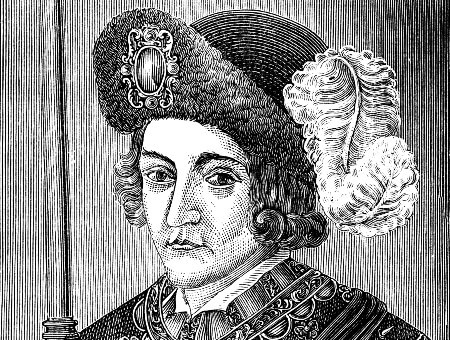
Peter Morgan, of Berkhamsted Local History and Museum Society, asks was Edward of Woodstock the castle’s most illustrious former resident?
On 8 June 1376 – 650 years ago this year – Edward of Woodstock, Prince of Wales and Duke of Cornwall, died. He was son of the King, became a national hero when still a teenager, married ‘the most beautiful woman in all the realm of England’, and chose Berkhamsted Castle as his honeymoon destination and preferred residence.
And yet, he died just before his 46th birthday, not on the field of battle, but in his bed, having never achieved his birthright, that of King of England and master of much of France. His death left a young son, totally unprepared to be King only a year later, leading directly to the Wars of the Roses.
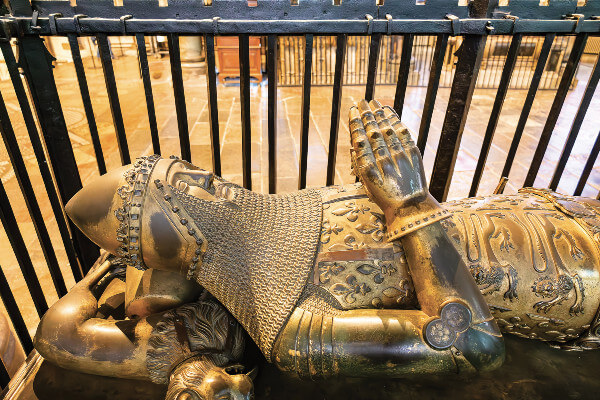
He is best known by a soubriquet for which the origin remains uncertain. Was he particularly brutal with his enemy? Did he wear dark armour? Or is it a name attributed after death because of the tarnished nature of his tomb in Canterbury Cathedral? Whatever the reason, he is most commonly known as the ‘Black Prince’.
Edward was the oldest child of King Edward III and Queen Philippa of Hainault. His life was dominated by what became known as the Hundred Years War, a series of conflicts between the Kingdoms of England and France starting in 1337, when Prince Edward was just seven years old. In that same year, the title ‘Duke’ was created by Edward III, when he made his eldest son Duke of Cornwall, the estates of which included Berkhamsted Castle. Today, approaching 700 years later, the castle is still owned by the Duchy of Cornwall, with the Duke still the eldest son of the King – Prince William.
Edward III left his eldest son in charge of England, with the help from a Council, from a young age and, in 1346, when he was only 16, Prince Edward was present at the battle of Crécy. Having found himself in trouble he made a request to his father for help. The contemporary report says the King responded: ‘Go back to him and to those who have sent you and tell them not to send for me again today, as long as my son is alive. Give my command to let the boy win his spurs…’ Tough love, indeed!
The young Prince, helped by longbowmen from Berkhamsted, held firm, and eventually the French retreated. A couple of years later he became the youngest member of the Order of the Garter, when Edward III founded this chivalric order at Windsor.
Those Berkhamsted archers were with Prince Edward again 10 years later, when, after rampaging through France, the English army met the French at Poitiers on 19 September 1356. The outcome of this was not just an English victory, but the capture of the King of France, John II, and his son Philip. Edward brought John back to England, where he was held at, among other places, Berkhamsted Castle. This ‘imprisonment’ would no doubt have included hunting excursions with Prince Edward.
Indeed, hunting was a big draw for Edward at Berkhamsted. He extended the Royal Deer Park and used it extensively when he was in residence.
In 1361, at the then unusually advanced age of 31, Edward married his cousin, Countess Joan of Kent, already twice-married and mother to four children. The wedding took place at Windsor Castle and they honeymooned at Berkhamsted Castle and then spent Christmas there, soon after which they were joined by the King and Queen. Edward and Joan had two sons, but only one survived to adulthood; the future Richard II.
In 1362 Edward was made Prince of Acquitaine and Gascony, and for many years campaigned in France and modern-day Spain, before returning to England in 1371. His health was deteriorating and he returned to Berkhamsted to recuperate. There were no more battles, and five years later he died at Westminster Palace of dysentery. He drew up his will the day before his death, leaving to the College of Bonhommes at Ashridge a ‘great altar of silver and gold, encrusted with rubies, sapphires and pearls and inlaid with a fragment of the ‘True Cross’. This was believed to have been destroyed during the Reformation.
Was The Black Prince Berkhamsted Castle’s most illustrious former resident? Let the debate begin!