
The house that became a corner of Neverland
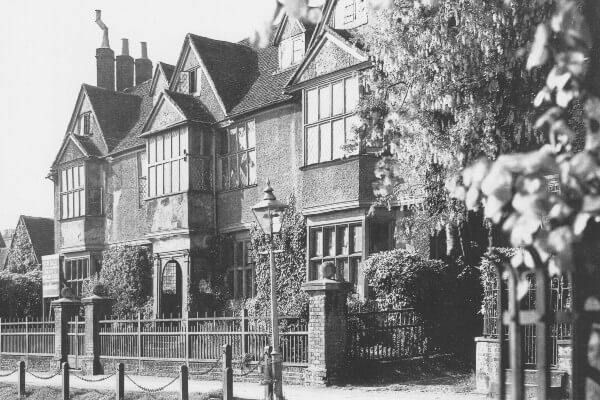
Where the Rex Cinema stands on Berkhamsted High Street there once was an Elizabethan mansion with a fascinating connection to the tale of Peter Pan, the boy who never grew up.
Egerton House, with its oak panelling, mullioned windows and long garden, was home to five young boys – and for a brief moment in the early 20th century, it became a corner of Neverland.
Egerton House was one of two great Elizabethan mansions in the town, the other being Berkhamsted Place, near Berkhamsted Castle. Both were demolished in the 20th century, but their stories linger. The name Egerton is interesting as Thomas Egerton made Ashridge his home in 1604, and there is some speculation that Egerton House was built as a Dower house, but historians have not been able to prove this.
Over centuries the house passed through local hands – the Kellets, Rev Dr Robert Brabant of St Peter’s, and others – before being bought in 1904 by the Llewelyn Davies family.
That purchase would change literary history.
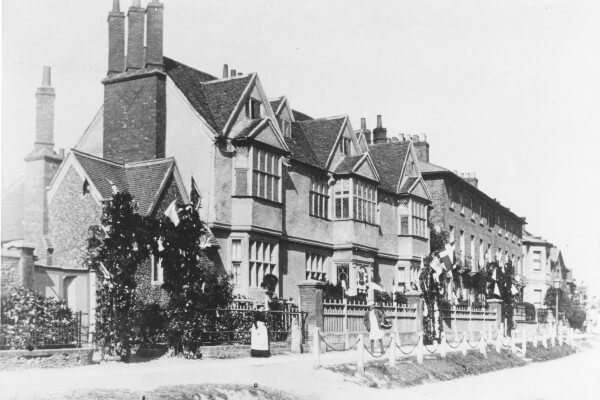
London barrister Arthur Llewelyn Davies and his wife Sylvia moved to Berkhamsted with their five sons – George, Jack, Peter, Michael and Nicholas. A frequent visitor was their close friend J.M. Barrie, already a celebrated playwright, who had first encountered the boys in Kensington Gardens. He wasn’t their only literary connection – Sylvia’s niece was the author Daphne Du Maurier, whose most well-known novels were Rebecca, My Cousin Rachel, and Jamaica Inn.
Barrie met George and Jack in Kensington Gardens when they were out with their nurse Mary Hodgson and the baby Peter. They were enamoured with his playful demeanour – wiggling his ears, dancing with his dog Porthos, and telling stories. ‘Uncle Jim’ became a regular part of their lives.
Barrie would tell the boys stories – one of which was about the youngest boy, Peter, who, Barrie said, would one day fly away to Kensington Gardens where he would be a boy forever. When children died, Peter would take them to a place called Never Never Land. Reportedly George, on hearing the story, declared that ‘dying must be an awfully big adventure!’ – the phrase later became the most famous from Peter Pan.
Michael was said to be Barrie’s favourite – he even took photographs of him dressed as Peter Pan, on a visit to Barrie’s country retreat, Black Lake Cottage, in 1901. Barrie captured a whole pirate adventure with the boys in a series of photos – the album titled The Boy Castaways of Black Lake Island. A copy is in the collection of Beinecke Rare Book and Manuscript Library at Yale University.
One early performance of Peter Pan was staged especially at Egerton House for the boys when one was ill – a private sprinkling of fairy dust in Berkhamsted High Street.
In 1904, the same year the family settled at Egerton House, Barrie’s play Peter Pan, or The Boy Who Wouldn’t Grow Up, premiered at the Duke of York’s Theatre.
In the printed play’s dedication he wrote: ‘I made Peter by rubbing the five of you together, as savages with two sticks produce a flame.’
Sadly, Arthur became gravely ill with cancer during their years at Egerton House. Barrie supported the family financially and emotionally, visiting often. When Arthur died there in 1907, Sylvia eventually returned to London. After her death in 1910, Barrie became guardian to the boys – a role that bound him to Berkhamsted’s ‘lost boys’ long after the family had gone.
Tragedy shadowed their story. George was killed in action in 1915. Michael drowned in 1921. Peter, who later struggled under the weight of his famous namesake, committed suicide in 1960. Even in death he couldn’t escape the link, with papers declaring, ‘The boy who never grew up is dead’.
Barrie died in 1937. At his funeral in Kirriemuir, Scotland, the Llewelyn Davies brothers were described as his adopted sons.
That same year, Egerton House was demolished to make way for the Rex Cinema. Efforts were made to save the mansion, but the cost of restoration was prohibitive after years of neglect. Photographs show its gables and tall chimneys leaning slightly into history, as if already retreating into storybook mist.
If you are interested in JM Barrie’s life, there’s an excellent resource at jmbarrie.co.uk, which includes photos inside Egerton House, and letters from JM Barrie and the boys’ mother and father.
An excellent, more detailed story is told by Berkhamsted local historian Linda Rollitt at rollitt.co.uk/the-lost-boys-of-egerton-house