
Tring’s Green Man
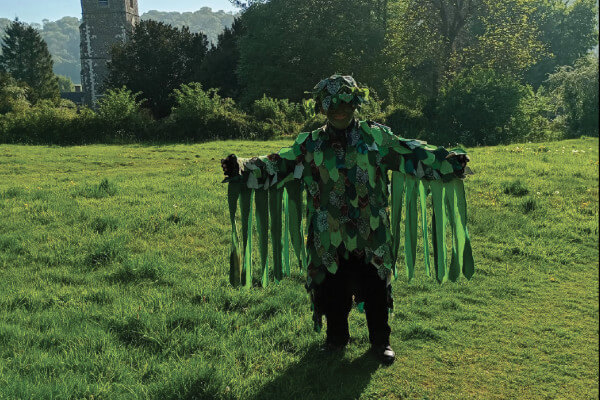
Martin Hicks is Tring’s very own Green Man, but his commitment to the natural environment and local rural tradition goes way beyond donning a costume for special events…
Martin Hicks has spent nearly four decades immersed in the life, landscapes and traditions of Tring. Originally from Walthamstow in northeast London, on the edge of Epping Forest, he moved to the area through work – and, as he puts it, ‘the opportunity of accommodation in a shed with a colleague’. Thirty-eight years later, he remains one of the town’s most recognisable and passionate champions of the natural world, local folklore and rural traditions.
By day, Martin works as senior ecology officer for Hertfordshire Ecology, where he helps scrutinise planning applications and ensures larger developments benefit wildlife through Biodiversity Net Gain and Local Nature Recovery Strategies. But outside the office, he is perhaps better known as Tring’s Green Man – a leafy figure celebrating the changing seasons and reminding people of their connection to the natural world.
‘Put simply, I was given a Green Man outfit by an old friend heavily steeped in the folk, morris and natural world, and one of the country’s last genuine deer-keepers,’ Martin explains.
For him, the Green Man is about far more than costume or performance. ‘The changing seasons are simply part of the pattern of life on this planet – but a part we no longer sufficiently value or are engaged with,’ he says.
Martin describes Tring’s Green Man as ‘more of a spiritual presence which reflects a life-force which underpins our environment’.
He points to the ancient Green Man carvings found in churches across the country, symbols often associated with fertility, spring and renewal, though their true origins remain uncertain’.
Interestingly, Tring itself has no Green Man carving, but it does feature a rarer ‘Wild Man’ or ‘Wodwose’ carving as part of the town’s historic bestiary. ‘A Wild Man is a whole body clothed in leaves and tangled hair, rather than just a foliate head and also represented perhaps the spirit of the woods,’ Martin explains.
His enthusiasm for folklore extends well beyond the Green Man tradition. Martin believes that folklore and seasonal rituals reflect humanity’s long relationship with the land and natural cycles.
‘I think spirituality and a certain degree of mysticism underpins a feeling for our environment and inspiration from the natural world, backed up by science and engagement with it,’ he says. ‘As a society we have always both exploited it but also nurtured it – but we have forgotten how to do the latter.’
He believes that, historically, communities celebrated the changing seasons because they understood how dependent they were on nature. ‘We revered and celebrated it with ceremonies, feasts and other festivities to mark the changing seasons and our involvement with them,’ he says.
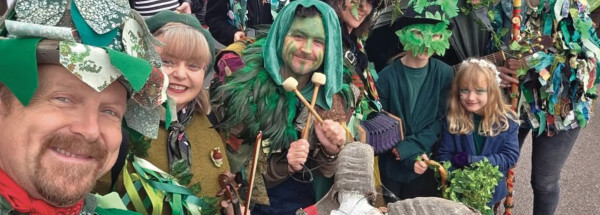
Martin worries that modern society has become disconnected from this relationship with the environment. Through folklore, music and community events, he hopes to encourage people to reconnect with both landscape and tradition. He dances with New Moon Morris at Ivinghoe and regularly joins Aldbury and Whitchurch Morris sides at seasonal celebrations, from wassailing apple trees to dancing around maypoles.
‘A chance to do something bizarre in public and get away with it,’ he jokes. ‘Sometimes…’
Martin is also deeply involved in supporting local food producers and independent traders. In 1999, he helped establish Tring Farmers Market as part of the Tring Environmental Forum. Opened by broadcaster John Craven, it became the first farmers market in Hertfordshire and one of the first in the country.
More than 25 years later, Martin remains a director of the market and continues to champion local produce despite changing shopping habits.
‘Local food is our local environment helping to feed us, and our producers, our community helping to achieve this,’ he says. ‘Or you can press a few buttons and buy it online, it’s cheaper (really?) and more convenient. But that comes at a significant environmental and social cost.’
The market also features music from the Market Mynstralls, a wandering group of local musicians with whom Martin performs.
Alongside his work in folklore and community events, Martin has dedicated much of his career to conservation. Earlier in his working life he worked with several wildlife trusts and the Nature Conservancy Council, and he helped save Tring Park from development threats while also opposing plans to turn Pitstone Quarry into landfill.
In his spare time, he undertook research into small mammals and coppicing for a PhD, has counted butterflies at Aldbury Nowers and Tring Park for nearly 30 years, and still helps manage conservation grazing sites around Tring – often involving the challenge of keeping sheep and dogs apart.
Despite the many changes affecting the countryside around Tring, Martin remains committed to protecting both the environment and the traditions that help people feel connected to it. Whether dressed as the Green Man, dancing with morris sides or advocating for local food and wildlife, he continues to celebrate the rhythms of the natural world and encourage others to notice them too.
About the area
What do you like most about living in/ near Tring?
‘It retains vestiges of its rural character as Hertfordshire’s last true market town, surrounded largely by a functional countryside, alongside a genuine sense of community and character with lots of activities, places and characters. But depending on your perspective, many of these are under threat. The times they are a changing – and always have done. HS2, more supermarkets, fewer farms, more horses, more floodlights, and 1,500 more houses on the horizon. Certainly, a challenging environment.’
Do you have any favourite spots for entertainment/ going for a walk/having a coffee/ going for a drink? Tell us why you like them.
I attend local theatres and local churches, depending on what is on, and enjoy walks in the local Chilterns or Aylesbury Vale.
There are several great hostelries in Tring, Marsworth and Ivinghoe. All are excellent venues, have excellent hosts and support excellent customers. And there’s even a local brewery too. Use them or lose them.
If you have any spare time – do you have any favourite activities or hobbies?
Morris dancing, smallholding, counting butterflies, playing music at local sessions, meditation at Amaravati and at seasonal events. Running the Apple Fayre and other events for the Spring Fayre, and scything Tring Churchyard. Plus yoga on occasion.