
Hertfordshire County Council is Leading the Way on Climate Action
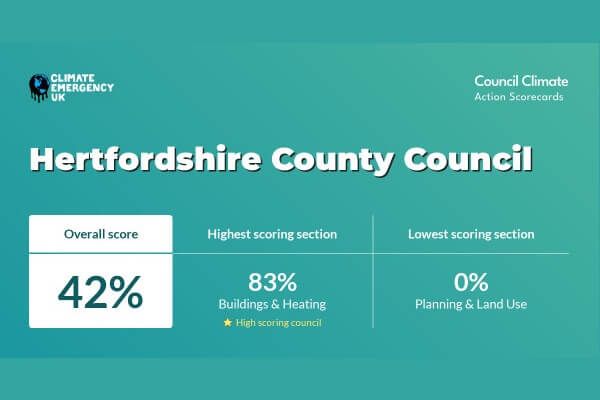
Hertfordshire County Council is the highest scoring council for climate action in Hertfordshire, according to Climate Emergency UK who published their second edition of the Council Climate Action Scorecards today, the only holistic analysis of all UK councils’ climate action.
Hertfordshire County Council scored 42% overall, closely followed by Watford District Council with 41%. These two councils obtained similar scores when Climate Emergency published the first Action Scorecards in 2023, scoring 42% and 40% respectively.
However, the scores vary across the county, with Broxbourne Borough Council scoring the lowest on 23% and Stevenage Borough scoring 34%. Welwyn Hatfield Borough Council saw the biggest increase from its 2023 score, showing an 11 percentage total improvement, and Stevenage Borough Council increased its score by 7 percentage points.
The average score across the South East was 39%, only slightly above the average across England was 38%.
This is the second time that Climate Emergency UK has undertaken this holistic assessment of what councils can do for climate action, what they can do to lower carbon emissions, cut residents’ energy bills, protect and create more space for nature and provide better public transport, among other things. The Scorecards are created by assessing councils according to a three stage marking process using primarily publicly available data from council websites, available before November 2024, as well as national data and Freedom Of Information responses from councils from Autumn 2024.
Whilst average scores remain low (38%), 80% of all UK councils saw an increase in their Scorecard results since 2023. Broxbourne Borough Council and East Herts District Council were the only councils in Hertfordshire to see a decrease in their scores, down 3 and 2 percentage points respectively compared to 2023.
Annie Pickering, Operations Director at Climate Emergency UK, said: ‘The majority of councils in Hertfordshire have improved their Scorecard results since 2023, showing that councils, along with residents, want to prioritise climate action to improve their lives and communities.
‘Yet the average overall score increase since 2023 was just 6 percentage points, even though in Hertfordshire it was lower at 2.6. This shows that councils across the UK are struggling to step up their climate action at the emergency pace needed because there are nationwide barriers making it harder for councils to deliver effective, high point scoring, work that would cut residents’ bills, make their homes warmer and raise funds for cash strapped local governments. These Scorecards provide proof of where councils need real investment from the national government so that every council can improve their score by 20% or more each time to make real progress towards cleaner, safer and more prosperous zero emission communities we need to thrive.’
Despite the small overall improvement, there are 58 councils across the UK that scored over 80% in one or more sections, such as Planning & Land Use, Buildings & Heating and Transport. Locally, only one council scored above 80% on any section, and this was Hertfordshire County Council who scored 83% in Buildings & Heating, though this was down from a score of 92% in 2023. This means that Hertfordshire County Council is taking significant action to make new and existing homes warmer and cheaper to heat by having strong climate commitments in their Planning policy and providing funding and advice to residents on retrofitting.
Elsewhere, East Herts and Watford both scored an impressive 70% in Collaboration and Engagement, which gives an indication of how well these councils are engaging with residents, schools and local organisations on climate action.
Miss Pickering continued, ‘The government may have a target for net zero by 2050, but these Scorecards results show that they are not doing enough to support communities and councils across the UK to decarbonise. With devolution set to change council structures in Hertfordshire, we want to see a legal duty to tackle climate change embedded in the new authorities created, as the Greater London Authority already has. Doing this would ensure councils have the funds and powers to protect residents from flooding, air pollution and rising energy prices that we know that residents care about, and allow councils to work beyond the next election cycle.’
Across the county and country, councils run by different political parties (Labour, Conservative, Lib Dem and in No Overall Control) all saw their scores increase, showing commitment to cutting costs and improving the lives of residents by tackling the climate emergency. This aligns with residents’ desires: the most recent poll in the UK showed that 72% of people, up 8 percentage points since 2022, are concerned about the impacts of climate change.