
Sixth formers put AI to the test
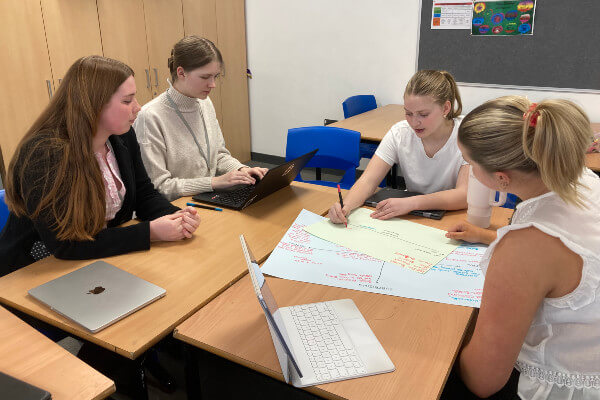
Tring School sixth formers recently teamed up with the Tring Local History Society to discover how useful AI is for history research.
Every year, the society supports Tring history students in writing articles for its newsletter. This year, 13 students – Beatrice Riley, Bhav Patel, Daisy Haynes, Emmy Brown, Laura McDonald, Lawrie Heaton, Melissa Burnell, Mia Moore, Olivia Osmond, Poppy Basford, Safia Alqassar, Seren Newman, and Will Bonser – worked with newsletter editor Jess Field to tackle the challenges and opportunities of AI head-on.
Students researched their topics using the usual sources, including Tring Local History Museum and its website. But they also kept AI notes – reflecting on the quality of the information from AI chatbots such as ChatGPT and Gemini. Everyone then joined a workshop to determine how local history researchers should approach these fast-evolving tools.
The short conclusion was that AI can be really helpful. Melissa, who worked on Tring’s banking history, says it is good for kickstarting research. Mia found it useful for summary information about her topic on local witch executions.
But the students advised caution. If the topic isn’t already online, AI models won’t know about it. And ‘hard copy sources hold the most valuable information for local history,’ Melissa pointed out. The trouble is, AI won’t admit that it doesn’t know something.
Bhav – who researched Tring’s proposed tramway – was frequently frustrated as AI ‘repeated the same link or would give wrong information’. Accuracy isn’t the only thing to consider. As Daisy noted, ‘the environmental impact of AI is too detrimental to just ignore’.
In the end, they came to an agreement that restraint is key. ‘AI is a positive resource… when used for the right reasons,’ Olivia concluded. But it will never replace local hard copy, object, or oral history sources.
The students wrote about their experience in an article for the British Association for Local History’s Local News magazine published in August. They’ve also produced AI mythbusting guidelines for other local history societies and researchers, available at tringlocalhistorymuseum.org.uk.
Pictured L-R: Mia, Laura, Melissa and Olivia