
Wartime comes to Waddesdon Manor
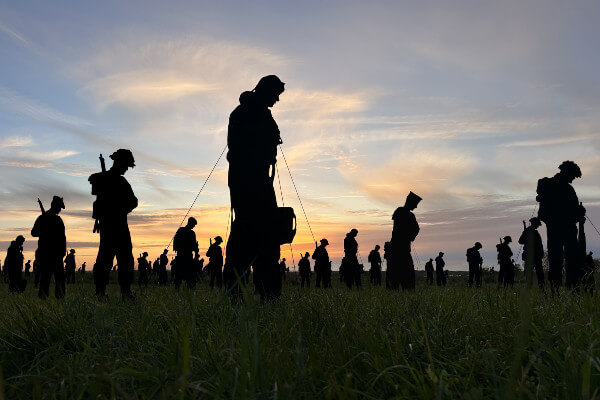
For five weeks this autumn (21 October-29 November), Waddesdon Manor will be transformed back to the wartime years with two extraordinary, immersive displays, plus a special appearance by a legendary theatrical creation.
The grounds will be host to a dramatic large-scale installation commemorating those who gave their lives for freedom during the D-Day landings (6 June 1944). D-Day 1476 – For Your Tomorrow, created by the charity Standing with Giants, will see 1,476 life size silhouettes populate the gardens – each one representing a life lost under British command on D-Day as well as the wider conflict.
And inside, the Manor will reveal and explore for the first time, the extraordinary story of how over 100 evacuees escaped the London Blitz sheltering in one of Britain’s grandest houses, a hugely different period in the life of the House.
The internationally-acclaimed installation, D-Day 1476 – For Your Tomorrow, has recently returned from a five-month display at the British Normandy Memorial in Ver-sur-Mer, Normandy, now visitors to Waddesdon Manor in the UK can experience this powerful tribute of remembrance. The installation continues to bring the human stories behind the silhouettes to life, honouring the individuals who served and sacrificed so much.
Including a number of Dawn and Twilight openings with special musical performances and events, the display features new silhouettes unveiled for the first time in the UK with the personal detail and history of servicemen brought even more to the fore through Beach Masters, Dog Handlers, Royal Navy Officers, Tank Crew, Merchant Navy personnel and Royal Engineers.
British Commando Frogmen and 50 French Resistance fighters will also be added, acknowledging the vital role of French civilians in the liberation of their country and European freedom.
Inside the House a new display, 1939-1945: A House Interrupted takes visitors into the lives of James and Dorothy de Rothschild, and the 100 nursery-age children from Croydon who left their parents and homes to live at the Manor. The story will be told through sound and archive images, as well as immersive displays evoking the period and the way the House was used. In a particularly poignant touch, visitors will be accompanied by the voice of Dorothy de Rothschild, who recorded a memoir of the time, bringing the story and the atmosphere to life.
Her account is full of touching vignettes, from the 4-year-olds skidding across the empty grand rooms, rows of day beds filling the Dining Room, and the Red Drawing Room transformed into a nursery where the historic wall silks became ‘rags’ thanks to all the sticky fingers. The display also brings home the realities of war as the children were bundled down to the cellars during air raids, accompanied by James and Dorothy. The evacuees were not the only young people to find sanctuary at Waddesdon. James and Dorothy also offered a home to a group of Jewish children from a Frankfurt orphanage, fleeing Nazi persecution in 1939.
Of course, alongside the children’s lives, both James and Dorothy played an important part in the war effort, James in Winston Churchill’s War Cabinet and Dorothy through her work with the Women’s Voluntary Service, so the displays, drawn from the archives, explore this parallel story of duty. There are also fascinating insights into the practicalities of managing the house and collections in such challenging circumstances, such as the discovery of a mysterious blue mould on the paintings whilst in storage, a potentially devastating problem crucially detected in time when the pictures were taken out of their frames, because the rooms had to be adapted for the children.
Much of the children’s time was spent outdoors for fresh air and exercise. An album of photographs from the archive made by one of the nursery helpers shows them through the seasons, from waterplay in the summer to snowy scenes in winter, a reminder of the length of time they spent away from their families. It was also in the gardens that they contributed to the country’s ‘Dig for Victory’ effort by helping grow cabbages and peas.
And alongside these two displays will be a special chance for one day only (Saturday 24 October) to see Joey – the astonishing life-sized horse by South Africa’s Handspring Puppet Company created for the acclaimed National Theatre production of Michael Morpurgo’s novel War Horse, a reminder of the many roles played by animals drawn into the conflict.
Dan Barton, Founder of Standing with Giants, said: ‘Standing with Giants is incredibly proud to be bringing our D-Day inspired installation to Waddesdon. It is especially meaningful for us to return here, following our WW1 Remembrance displays at Spring Hill and the Walk of Remembrance in 2021 and 2022.
‘There is something incredibly special about this setting. It is a place where history, beauty and remembrance come together in a unique way. This installation honours the courage and sacrifice of those who served on D-Day, and as we mark 82 years since 6 June 1944, offers a powerful space for reflection and remembrance. Visitors often leave our installations with a deeper appreciation of the courage, sacrifice and humanity of those who gave so much for our freedom.
‘Each figure represents an individual story from a moment that changed the course of history. Our aim is to humanise the scale of loss so that remembrance remains personal, relevant and meaningful for future generations.’
Waddesdon Manor Director, Pippa Shirley, said: ‘We are so proud to be working with Standing with Giants and that Waddesdon Manor is hosting this extraordinarily powerful and timely installation connecting so many of us to our history and present. Many great country houses have a wartime history as their lives and purpose was completely transformed, socially, politically and economically, by the conflict that convulsed the world. At the Manor, this was particularly profound, not only through the numbers of estate staff many of whom were conscripted and gave their lives but through James and Dorothy’s determination to play their part through duty and service and of course the presence of the children. Being able to tell this story in the house to complement the installations has been a revelation, and I’m sure it will be to our visitors too, drawing out new human insights from the archives to complement the emotional impact of the installations. It demonstrates more clearly than anything we have done previously that war touches everyone, at every level, and at this particular moment it seems more important than ever to understand and learn from our shared history.’
To book admission for the Standing with Giants installation or for the Dawn or Twilight openings, visit the Waddesdon website.
1939-1945: A House Interrupted is free with a ground’s admission to the Standing with Giants display.
Image © Standing with Giants